Daniela

“I attended YogaBirth classes from 16 weeks. I had had a complicated history and was classed as high risk of premature birth, however, the teacher’s knowledge and experience meant that I was in safe hands.

Movements were either adapted to my needs or alternatives were provided. Each week I would learn from both her extensive knowledge of anatomy and the birth process. Our open discussion at the start of each week provided comfort in knowing the other attendees were experiencing similar symptoms and feelings, and often C. was able to recommend Yoga poses to alleviate discomfort.

I will forever be grateful for the breathing exercises, which I found essential in labour and came automatically to me as I had begun lessons early on. The humming/meditation techniques we were taught felt strange in lessons and yet I tried them on my newborn and found that it soothes a screaming newborn and continue using humming to this present day (she is 17 weeks old). I am so glad I did YogaBirth and highly recommend it.”

Yoga Scotland Pregnancy Guidelines

Guidelines for Teaching Yoga to Pregnant Women

Pregnancy is a normal and natural part of a woman’s life cycle and the majority of young pregnant women are fit and well. However, many will suffer from one or two discomforts which come with most pregnancies and a minority will encounter a problem needing treatment by a qualified health professional.

Yoga is a physical and spiritual practice and is ideal for pregnancy as it develops balance, confidence and self-awareness. Many women now do some form of exercise before they be- come pregnant and Yoga provides a perfect way to keep exercising to maintain health and fit- ness during pregnancy without strain. Furthermore, it develops the kind of flexibility of mind and body required in labour.

Yoga is as much a philosophy and way of life as an exercise. Whilst many of the Guidelines for Exercise in Pregnancy are still relevant (NHS 2014), not all are necessarily applicable, since they relate to exercise in general rather than Yoga. The following advice should be considered in relation to Yoga.

1. Advice to women

1:1 Discuss with your midwife the most appropriate Yoga class to join if starting for the first time. Ideally you should join a class taught by a teacher qualified in Pregnancy Yoga. Failing this, choose a beginners class or one with a slower pace. More physically stren- uous forms of yoga practice involving fast-flowing aerobic sequences, raising body tem- perature, and breath retention practices are not appropriate in pregnancy.

1:2 If already practising Yoga asana, continue to practise whilst acknowledging your chang- ing body, and be prepared to slow down, modify or cease practising postures which cause discomfort or pain, preferably with reference to your yoga teacher (Clapp 2006).
Always inform your teacher of any discomforts or concerns arising through your preg-
nancy.

1:3 Stop exercising or practising Yoga if feeling light-headed or fatigued. Sit or lie down and
practise simple relaxed breathing.

1:4 Drink plenty of fluids – bring a bottle of water to the Yoga class and eat something light
beforehand e.g. banana, piece of toast and bring a snack for the end of the class.

1:5 To complement your Yoga practice, choose a ‘light to moderately hard’ form of exercise
such as walking or swimming to develop muscle tone, strength and stamina. Gradually increase this exercise to two or three times a week (Clapp 2012). Note that a moderate level of exercise may protect both mother and baby e.g. from raised blood pressure (Yeo 2008).
Recommendations to Yoga Teachers

2. General advice
Reiterate all the recommendations and advice in Section 1 (Advice to Women) and in addition:

2:1 Direct women to a dedicated pregnancy Yoga class where possible.

2:2 Advise women joining a Yoga class for the first time to wait until 14 weeks or so. By this time the initial fatigue and possible nausea should be starting to lift. Pregnant women who already practise Yoga should be advised to slow down in their practice and be sensitive to the changes in their body. Moderate exercise is not a risk factor for miscar- riage (RCOG 2008) and may help to protect the baby (Clapp 2012) and benefit the mother (NHS Choices 2014). The most common time for miscarriages to occur, from
whatever cause, is usually before 13 weeks.

2:3 Ask women to inform you of any problems that might arise from week to week.

3. On practice
Consider the following with respect to movement, joints and breathing:

3:1 Focus on finding the ground (grounding), lengthening the spine and postural balance with breath awareness.

3:2 Encourage women to move their legs regularly when standing, especially women with low blood pressure or anaemia. Prolonged standing can result in pooling of blood in the lower limbs, leading to a drop in blood pressure – dizziness, nausea etc. This is more common in the hot summer months.

3:3 Encourage women to move slowly from lying down to sitting, carefully keeping their legs parallel to avoid stress on the pelvic joints.

3:4 Encourage fluidity of movement with an emphasis on flowing rather than static move- ment.

3:5 Focus on promoting core stability with attention to the pelvic floor.

3:6 Promote an awareness of optimal foetal positioning by including upright forward-leaning
positions e.g. all-fours, every week (www.spinningbabies.com).

3:7 Offer alternatives for women with pelvic girdle pain (PGP) (formerly known as SPD) –
primarily alternatives that promote the release of tension and restore the balance of
forces through the pelvis (www.pelvicinstability.org.uk).

3:8 Be sensitive to the fact that some women are uncomfortable touching other women. Of-
fer alternatives for any partner work.

3:9 Note that pregnant women may have a tendency to hyperextend joints and that this
should be avoided.

3:10 Take care when teaching any posture involving full flexion of the joints, especially with
beginners. In the first instance modify the pose using props e.g. cushions for kneeling.

3:11 Avoid jumping in and out of postures. These can cause unnecessary stress on the pel-
vic floor, joints and ligaments and can exacerbate structural imbalances.

3:12 Ask women to lie on their left sides and not on their backs for relaxation from about 30
weeks to avoid supine hypotension – experienced by about 10% of pregnant women.
(Fraser and Cooper 2009). Ask them to come up slowly after relaxation.

3:13 Be aware that prior to 30 weeks women lying on their backs should place some support beneath the thighs. This will release tension in the lumbar spine and psoas. Alternative- ly women can lie with the knees bent and resting together, with the feet placed on the
floor a little wider than the hips.

3:14 Avoid any breathwork/pranayama that involves breath retention. Focus on developing
an awareness of the breath and then on the benefits of extending the out breath. Use of sound can be particularly helpful in encouraging extension of the out breath and can al- so bring a calming quality e.g. gentle bhramari. Practices such as Kapalabhati and Bhastrika are not recommended in pregnancy.

3:15 Emphasise and teach relaxation and breathing practices. Pregnant women benefit par- ticularly from a longer relaxation at the end of a class with plenty of cushions and props for support.

4. Postures/asana
Consider the following in relation to specific postures/asana:

4:1 Focus on teaching narrower versions of the classical wide-angle standing postures such as Trikonasana (Triangle), Virabhadrasana (Warrior) etc. These postures, practised with any side-bending, can over-stretch ligaments, create torsion and shearing within the sacro-iliac (SI) joint, twisting in the knee joint, collapsing of the arch of the foot and do little to promote strength and stability (Blackaby 2012). Wide-standing with feet par- allel will offer some protection to the SI joints.

4:3 Recognise the difference between high and deep squatting (either on the balls of the feet or with heels down). In general, unless the woman finds squatting easy, deep squats should be supported (by partner) or practised using props (e.g. roll/blocks under heels/supported against a wall/sitting on a low stool/leaning forward onto support). Great attention should be taken to the position of the feet in relation to the knees to maintain alignment. In addition care should be taken in teaching how to come in and out of the pose to avoid excess loading on the knee joints, e.g. by rocking back and forth from all-fours. Consideration also should be given to avoiding deep squatting under the following circumstances:
· History of premature labour
· Knee problems where hyperflexion is contra-indicated
· Haemorrhoids
· Recent unexplained bleeding
· Baby is in the breech position in the last six weeks of pregnancy · The woman feels very uncomfortable
· Pelvic Girdle Pain
· Placenta Praevia

4:4 Be aware that kneeling involves hyperflexion of the knee joint and hyperextension at the ankle. Pressure on the calves can aggravate varicose veins, and can also impede the venous return from the lower limbs leading to light-headedness, particularly if blood pressure is low. So do not hold for too long.

4:5 Take care when teaching twists. Avoid strong twists as these can increase separation of the rectus sheath.

4:6 Avoid teaching full inversions e.g. Sirsasana (Headstand) and Adho Mukha Vrkshasana (Handstand). Only a few women with a strongly established Yoga practice may like to continue these into the second trimester – perhaps close to a wall for reassurance. Par- tial inversions such as Adho Mukha Svanasana/Sumeru Asana (Dog Pose), and modi- fied Viparita Karani Mudra (Half Shoulderstand) may be taught with legs up the wall with support of a wedge or cushions under hips and lower back. This will help increase the angle at the hip which will further help to relieve congestion in the legs. Adho Mukha Svanasana/Sumeru Asana (Dog Pose) and knee/chest pose can be used to encourage a baby in the breech position to turn. However, once head-down, the mothers of these babies (usually from 37 weeks or so) no longer wish to practise these partial inversions in case the baby turns back again.

4:7 Avoid the more advanced backbends e.g Ustrasana/Ushtrasana (Full Camel) and Urdhva Dhanurasana/Chakrasana (Wheel), as they tend to create further compression of the lumbar spine and to over-stretch the abdominal muscles (Robin 2002). Teach Vi- rabhadrasana I (Warrior I) and modified Eka Pada Rajakapotasana (Pigeon) as more helpful alternatives.

4:8 Note that postures that strongly tighten the abdominal muscles e.g. Navasa- na/Naukasana (Boat Pose), are contra-indicated as these tend to further separate the rectus abdominis. Choose a flowing Cat sequence (Cakravakasana/Marjariasana) in- stead for abdominal and core stability.

4:9 Take particular care when teaching balances. Balancing postures in themselves pro- mote strength, concentration and a deepening of internal focus. However, pregnant women tend to lose their balance more easily and feet may be swollen, arches less supportive etc. Practising close to a wall may be helpful.

4:10 Setu Bandhasana/Dvipada Pitham (Bridge Pose), pelvic tilts, Apanasana (supine squat) or any posture that involves lying on the back can be continued for short periods after 28 weeks as long as the woman remains symptom-free and the practice is not static (see 3:13) (Clapp 2012).

For Help, Support and Further Information Contact

YogaBirth :
Judy Cameron: judycameron.yoga@gmail.com
Kay Millar: kay.millar0@gmail.com

References

Blackaby P. (2012), Intelligent Yoga (Outhouse Publishing).
British Wheel of Yoga (2013), ‘Operating Procedures ED19a Guidelines for Teaching Yoga in
Pregnancy’.

Clapp J. (2012), Exercising Through Your Pregnancy, Second edition (Addicus Books).

Clapp J.F. (2007), ‘Uterine blood flow during supine rest and exercise after 28 weeks of gesta- tion’, MIDIRS Digest, 17:1, 55-56.

Clapp J.F. (2006), ‘Influence of endurance exercise on diet and human placental development and fetal growth’, Placenta, 27, 527-534.

Fraser D.M. and Cooper M.A. (2009), Myles Textbook for Midwives, Fifteenth edition (Churchill Livingstone).

Madsen M., Jorgensen T., Juhl M., Olsen J., Andersen P.K., Andersen A.N. (2007), ‘Leisure time physical exercise during pregnancy and the risk of miscarriage: a study within the Danish

National Birth Cohort’, BJOG: An International Journal of Obstetrics and Gynaecology, Nov 1 2007, 114 (11), 1419-1426.

NHS Choices (2014), ‘Exercise in Pregnancy’, www.nhs.uk/conditions/pregnancy-and- baby/…/pregnancy-exercise.aspx

Pelvic Instability Network Scotland, www.pelvicinstability.org.uk.

Robin M. (2002), A Physiological Handbook for Teachers of Yogasana (Fenestra Books).

Royal College of Obstetricians & Gynaecologists (2008), ‘Early Miscarriage: information for you’.
Spinning Babies: www.spinningbabies.com

Yeo S., Davidge S., Ronis D.L.I., Antonakos C.L., Hayashi R., O’Leary S. (2008), ‘A compari- son of walking versus stretching exercises to reduce the incidence of preeclampsia: a random-
ised clinical trial’, Vol 27/2, 13-130.

Further Reading

Active Birth Website: www.activebirthcentre.com

Balaskas J. (1994), Preparing for Birth with Yoga Element (out of print)

Buckley S. (2005), Gentle Birth Gentle Mothering (One Moon Press).

Campbell M. (2012), Yoga of Pregnancy Week by Week (Findhorn Press).

Coulter H.D. (2001), Anatomy of Hatha Yoga Body and Breath.

Gaskin I.M. (2003), Ina May’s Guide to Childbirth (Bantam Books).

Gordon Y. (2002), Birth and Beyond (Vermilion).

Sutton J. (2007), How Will I be Born? (Birth Concepts).

Teasdill W. (2005), Yoga for Pregnancy (Gaia Books; out of print). Yogabirth Website: www.yogabirth.org


Judy Cameron & Kay Millar
YogaBirth July 2014

Your Birthing Ball

The Birth Ball is a valuable tool, which can help you remain in control during labour. Its unique design provides physical support for you in pregnancy, labour and the postnatal period. It is an excellent alternative to a chair for sitting and can also be used in a dynamic way to practise exercises and positions in preparation for labour. At the same time it induces a sense of calm and relaxation. Working with the ball helps to move your baby into the best possible position prior to and/or during labour. Such a position favours an easier and shorter labour. The beauty of the ball is its simplicity: it is comfortable, fun and easy to use.

How the Ball Works

The ball can be used in many ways but essentially it provides support. For example, when sitting astride the ball, there is no muscle tension because the thighs and perineum are supported by the gentle counter pressure from the ball. The feet are firmly grounded, and the spine will naturally adopt a position of good alignment. At the same time the muscles supporting the spine strengthen over time. Thus the incidence of pain in the lower back and pelvic joints decreases. In addition the ball appears to enhance the tone of the abdomen and support the pelvic floor, already under strain during pregnancy.

Before you Begin

Birthing balls are available in several sizes but the most common is the 65cm, (this is for someone with a height of up to 175 cm or 5 ft.9 ins. which should be inflated to no more than a height of 65 cm or 25.5 inches. Measure 65cm on the wall with a ruler and pump the ball up to this level.
The ball can be inflated with compressed air from a garage. Or with a foot or hand pump, such as you would use for an airbed. The ball should feel firm but give a little when you sit on it. However, it may soften a little over time so remember to check and pump it up again when necessary.
As you sit on the ball, keep your legs open with your feet firmly resting on the ground. Your hips should be significantly higher than your knees with thighs turned in the same direction as your feet. Make sure your knees are directly over your ankles.

Other sizes of ball include (Height, Ball size, Inflation, Height):

  1. 55 inches (140cm), 42, 42cm, 16.5”
  2. 61 inches (155cm), 53, 53cm, 21”
  3. 69 inches (175cm), 65, 65cm, 25.5”
  4. over 69 inches (above 175 cm), 75, 75cm+, 29.5” +

This ball can support (880 lbs) (62.8 stone) or (400 Kgs) however if the surface of the ball is scratched, cut or punctured or damaged its integrity can be lost and the ball can burst instantly. So balls do need to be cleaned and checked regularly. Cleanse with antibacterial soap/cleansing agent.

Use during Pregnancy

  • Kneeling on the floor you can lean your upper body over the ball, either with your back horizontal, or by easing your hips down towards your heels. You can also circle your hips in the more upright kneeling position. This can be a relaxing position to ease backache and it also avoids tension and weight on the wrists. Resting and relaxing in these positions will encourage the weight of your baby’s body to lie forward against your belly. This is important in the last 6 weeks of pregnancy when your baby’s head is attempting to engage in the pelvis. This can help to avoid a “posterior birth” when the baby’s spine lies alongside the mother’s, a birth that can be associated with a longer and potentially backache labour.
  • Sitting fractionally forward on your ball, place your feet apart
    and allow your bottom to sink into the ball comfortably. This
    will enable you to sit with your spine in good alignment,
    which can relieve backache and symptoms of heartburn. If
    you su er from pelvic pain, the ball can provide excellent
    support, relieving discomfort. Just make sure that the feet
    are not placed too far apart.
  • You can also use your ball to sit at a table or desk. This will encourage good posture and discourage you from crossing your legs, a habit which can work against engagement of your baby’s head as well as reducing the circulation to your legs and aggravate SPD.
  • Use the ball as a firm but comfortable support whilst sitting on the floor, during the day or evening watching television, reading etc.

Use during Labour

  • Once you have become familiar and comfortable with your ball during pregnancy, you will know how best to use it during labour when the time comes.
  • Your birthing partner can massage your lower back during contractions while you are kneeling and resting over the ball.
  • Standing and leaning over the ball, either placed on a high bed or against a wall will enlist the help of gravity to encourage your baby to descend.
  • Sitting on the ball you can sway and move your hips moving back and forth in whatever way you feel will help to move your baby through your pelvis and birth canal.
  • Remember it is easy to get up o  the ball and return to it later.
  • Kneeling on the floor and leaning over the ball will help the weight of your baby to rest forwards without putting pressure on the major blood vessels (inferior vena cava and aorta). This will improve the blood supply to the uterus and ease the pain of contractions. Note: it is possible to use gas and air (Entonox) while using the ball.
  • Using your ball is a comfortable way of feeling supported in labour whereas being on your back could slow down or make your labour more painful.
  • Leaning over your ball and rocking helps your baby to turn and drop deeper into the pelvis with increasing flexion of your baby’s head (chin to chest). As labour progresses the back of your baby’s head creates an even pressure on the cervix, enabling e ective dilatation and steady progress.
    When you are ready to give birth, you may need a di erent form of support. Your partner can sit on the ball, which can be wedged up against the wall, allowing you to kneel in front with your elbows resting on your partner’s knees.

After the Birth

The First Few Days

  • Sitting on your ball can be comfortable, especially if your perineum is sore.
  • Sitting on your ball and circling your hips will firm and tone the hip, buttocks, inner and outer thighs and abdomen.

Pelvic Floor Exercises

  • The ball provides excellent support when practising pelvic floor exercises.
  • Make sure the ball is su ciently inflated so that when you sit on it, the angle between your upper body and thighs is about 100 degrees (slightly more open than a right angle). Your feet should be placed at a similar distance to a squat but with your knees above your heels.
  • Next locate the Neutral Position. Roll back gently on to your coccyx until your lower back becomes slightly rounded. Now rock gently forwards until your bottom sticks out a little and your lower back curves inwards. Next move gently back to the midpoint between these two markers. This is the Neutral Position. Allow the buttocks to sink into the ball and elongate your spine in an upwards direction, with the crown of your head leading. Do not overarch the lower back.
  • Next take a gentle breath in and as you exhale push your sitting bones down into the substance of the ball without clenching your buttocks or using your leg muscles. Allow the crown of your head to lift at the same time. Once you begin to get used to this, you will experience the pelvic floor working around the back passage.
  • Next, take a gentle breath in and then slowly rock forward on the out-breath and observe what is happening to the pelvic floor. The muscles automatically begin to firm around the urethra and vagina. Work with this natural movement as you practise your pelvic floor exercises (see your hospital leaflet).

Other Postnatal Uses

  • When you feel stronger you can begin to bounce slowly to improve general muscular strength. N.B. Bouncing would not be recommended if the pelvic floor was still weak. However, gentle bouncing should be possible by six weeks following an uncomplicated vaginal birth.
  • Progress to firming your abdominal muscles by sitting on the ball with feet apart. As you exhale, tighten your belly below the navel, starting with your pelvic floor, lifting gently upwards and feeling your stomach becoming firm. Hold for 5 breaths before relaxing the muscles on an in breath. When you find this easy, sit on the ball and ensure that your lower back is not over- arching. Once you begin to feel the lift within the spine, tighten your belly as above and slowly lift one arm. Ensure that your shoulder blades do not lift. Try not to wobble and progress with both arms together and repeat 5 times (floating arms).
  • Lie on your back with your legs resting over the ball and your head supported on a folded blanket or a cushion to prevent any arching of the neck. Place your hands lightly on your belly and breathe in slowly. As you breathe out, engage your pelvic floor and lift it upwards, feeling your abdominal muscles tighten gently. Rock your knees very slightly to the right (maximum 2 inches). Pause for a moment and take in a full breath, releasing your tummy muscles. Then, as your breathe out, engage your pelvic floor, lifting to make contact with your deep abdominal muscles before bringing your knees back to centre. Pause once more, breathing softly and steadily before repeating on the opposite side.
  • The ball can be used to calm and soothe your baby. Simply sit on the ball with your baby and gently bounce or sway rhythmically. In this way the mother or father can have freedom of movement support to their backs whilst keeping the shoulders more relaxed and is an excellent aid to comforting your baby.
  • Some babies gain relief from colic by being placed on their stomach, face down with a firm hand at their back for support. Then gently roll the ball back and forth. The pressure on the baby’s abdomen appears to help with abdominal cramping.
  • Siblings love the ball too!

For Midwives

In The same way the ball if properly inflated can bring support and comfort to the spine, the ball can be a useful seat for a midwife attending a home or hospital birth so that she can sit and observe the labouring woman.

YogaBirth 2006
www.yogabirth.org

References

Anderson T. (1998) Me and my birth ball The Practising Midwife September 1998 vol 1 no9 pp38

Johnston J. (1997) Big Balls and Birthing Australian College of Midwives (Victorian Branch) Open Line
Winter 1997 vol 5 no3 pp7

Perez P.G. (2000) Birth Balls: use of physical therapy balls in maternity care Cutting Edge Press

Pucher M. Guide to the exercises with the Original PEZZI ball Ledragomma

Shallow H. (2003) My rolling programme: The birth ball: ten years experience of using the physiotherapy ball for labouring women MIDIRS Midwifery Digest vol 13 no1 March 2003 pp28-30

Stocker Margarethe (2003) Lead Physiotherapist, Royal Cornhill Hospital, Aberdeen

Sutton J. (2001) Let Birth be Born Again Birth Concepts UK


Yoga and Health Asana

Guidelines for Teaching Yoga to Pregnant Women

Introduction

The new guidelines for teaching yoga to pregnant women were launched in February 2010 by Yoga Scotland (www.yogascotland.org.uk) These were written in conjunction with YogaBirth (www.yogabirth.org.uk) and, as a member of both organisations, I was invited to lead the project. In a previous article I summarised and introduced the background to these guidelines. Below follows a more in depth explanation of some of the recommendations.

Grounding, the Breath and the Pregnant Woman

Over millennia our bodies have evolved in the context of gravity and the downward force it exerts upon us toward the Earth. Hence we have developed a musculo-skeletal system that allows us to walk, run or jump when we wish. When this action is not required we can rest by releasing any tension simply by giving weight to our bones. We can do this when standing, sitting, lying down, inverted or resting on all fours. This is grounding.
The problem we face as yoga teachers is that many women choose to take up yoga for the first time when they are pregnant. If, as for many women today, their lifestyle has been predominantly sedentary, they may have developed certain habitual tendencies e.g. to tilt the pelvis in a particular way when standing or sitting, to be generally weak in their core muscles as a result of lack of attention to posture etc. The hormones of pregnancy and the added weight tend to exaggerate these tendencies which can in turn lead to stress and strain upon different joints causing discomfort and pain. Grounding and posture therefore are fundamental to a sound yoga practice.
When we stand grounded in Tadasana there is some tone in the abdominal muscles but this is part of the natural response to gravity. It is not artificially held (Blackaby 2009). The pelvis, the main weight bearing structure of the body, distributes the force through the bones of the legs so we can give weight to the feet – the heels, the inner and outer foot. The arches within the foot respond to create support which is mirrored within the diaphragms above, notably the pelvic and thoracic diaphragms. Tone is brought to the pelvic floor and breathing is distributed between the chest and the belly.
Once we start to tighten the belly and the pelvic floor deliberately, we begin to interfere with this natural process and breathing becomes less responsive to gravity. Through regular practice, yoga can change unhelpful habitual patterns of breathing. We begin to notice the more subtle shifts in our breathing as we move from each asana to the next (Blackaby 2009).
This is crucial for the pregnant woman. She needs to discover how the power of the breath can lead her, for example, from a state of rest in deep relaxation to a flowing movement with typical responsive breathing as the surges of energy from the womb signal the contractions of labour. Finally it is through the help of gravity that she will give birth.

Narrow versus Wide-Angle Standing: the dilemma

The wider stances seen in many of the standing asanas practised today in the West require closer scrutiny when considering the needs of the pregnant woman and her softer, heavier body. If we take the legs into a basic wide stride stance, we may see that for many people the wider the legs are taken apart, the further forward the pelvis has a tendency to tilt. This tendency resides in tension held in the pubofemoral ligaments and the pectineus muscles as the legs are taken wider (Blackaby 2005). For the pregnant woman whose pelvis will gradually tilt forward as her pregnancy progresses, this posture could lead to unhelpful compression of the lumbar spine with pressure on the nerves as they emerge from that part of the spine. Practising wide stance poses could actually increase the cause and symptoms of back pain in pregnancy.

Warrior

If we then turn the feet in a wide stance, as for Virabhadrasana I, the anterior tilt may further increase, particularly if there is tension in the iliopsoas muscle. Tightness in this muscle is a common feature of a sedentary lifestyle where the hip remains flexed for prolonged periods in the sitting position. This version of Virabhadrasana could result in simply more lumbar compression.
More problems emerge from this posture as the woman attempts to draw the pelvis around to face the front leg leaving the back foot turned out. This sets up a twisting force through that back leg which in turn is transmitted through the knee joint. As the joints of pregnant women soften in response to the hormonal effects of pregnancy, this movement becomes particularly hazardous. Add to this the fact that grounding becomes increasingly more difficult the wider the legs are taken, we begin to see collapsing of the foot arch in the back foot, a situation which is hard to resolve until the stance becomes narrower.
A more sensible approach would be achieved by taking the feet a walking pace apart with both feet and pelvis facing in the same direction. Grounding is achieved more easily through the back foot and so the arch of the foot is able to retain its support. Any rotational forces within the knee joint are removed and in fact we now have a healthy stretch introduced to the Achilles tendon of the back leg, a stretch which is not present when the foot is turned out (Blackaby 2005). This healthy stretch is particularly helpful to the pregnant woman as it is one of the ways well known to physiotherapists and pregnancy yoga teachers of pre-empting and counteracting the uncomfortable and often painful leg cramps characteristic of pregnancy.
Warrior poses are synonymous with power and strength. Women can access these aspects of the pose in a practice that is both connected to the ground and the breath, while at the same time integrated with the response of the spine and the pregnant body. A safe practice evolves so that women can access the gentle confidence and feminine grace of a healthy pregnancy.

Helpline and Updates

We were very keen when we wrote these guidelines that they should be kept up to date in line with the evidence available. There is an e-mail Helpline that can be accessed to contact either myself judycameron@yogabirth.plus.com or Kay Kay.Millar@virgin.net . In pursuit of the very best we can offer pregnant women, we welcome your questions, your comments and your ideas.

Judy Cameron
April 2010

For more information about how to train as a YogaBirth teacher, please visit www.yogabirth.org.uk or contact either Judy or Kay via the Helpline.

British Wheel of Yoga Scotland

Active Birth is an essential dimension to pregnancy.  Many of us are familiar with the concept of Active Birth. To midwives it often conjures up images of women adopting upright positions for labour and birth. To the women and many childbirth educators the concept may spill out beyond the physical, and the implication of becoming active in mind takes on new meaning.

In actual fact the term Active Birth was first coined by Janet Balaskas in the late 1970’s as a then reaction against the highly interventionist management of labour with drugs that had, at the time, become very fashionable within the world of obstetrics. Women frequently gave birth on their backs in order to facilitate the monitoring and procedures surrounding birth. However, many of us forget that until the mid twentieth century – when the majority of births in the UK took place at home – the majority of women gave birth on their left side. Interestingly this is a far superior position within which to give birth – first because it is considerably less painful and second because the statistical chance of tearing is significantly reduced.

I first started to question the whole birth ritual as a student nurse in 1977. I spent 12 weeks in the maternity wing of a general hospital. In the Labour Ward I witnessed births that were highly managed with epidurals and drugs to induce the process – and I also saw women giving birth almost without any help at all. There were the sweetest of midwives caring for them – and there were also the most terrifying. It was the terror that drove me to give up the place I had been offered to do my midwifery training. It would not be for another 24 years before I actually became a midwife.

After many years of working as a nurse, when I became pregnant with my first child I started to practise yoga. This was triggered by Janet Balaskas’ Active Birth Handbook which my best friend gave to me with the recommendation “..this is all you need. Don’t read any other book.” And she was absolutely right. Everything in that book made total sense to me. I practised yoga. I swam. I rested. I went for walks. Everything I did for myself, I did for my baby. In my husband’s eyes I was beautiful – and I felt beautiful. I also felt strong and powerful. I was so happy. And it was in this state of happiness that I went into labour and had what I could only describe at the time as “the most beautiful experience ever”. Not surprisingly I had a similar, albeit much quicker, birth the second time at home – kneeling on the floor, resting my arms over two enormous floor cushions wedged into the sofa.

I could have gone on giving birth over and over because I had enjoyed it so much but instead I decided to train as an Active Birth Teacher with Janet Balaskas . I wanted to be able to pass on this knowledge to other women. The direction I took eventually led me into midwifery and then on to becoming a British Wheel Module Provider for the Pregnancy Module and the YogaBirth Course Director.

Since I first began this work nearly 20 years ago, I have noticed the proliferation of courses in Yoga for Pregnancy, Mindfulness-based childbirth, Hypnosis for childbirth, Hypnobirthing and so on. Indeed I have trained in meditation, hypnosis and HypnoBirthing myself. They are all valid and wonderful ways to prepare for the birth of a new life and I celebrate and rejoice in the fact that there are so many.

All these approaches recognise a dimension to pregnancy and birth that is so often missing in a standard antenatal class. Any yoga teacher in Scotland with a strong commitment to helping women in this wonderfully active way, might like to consider the British Wheel Pregnancy Module which commences in Dundee in June 2014.

Yoga and Active Birth

Practice these every day

Cat Marjariasana

Cat Marjariasana/Bidalasana
Free the pelvis with the breath and explore the possibilities of movement

Hare Pose Shashankasana Exhale into the back of your pelvis and be easy with the space across your sacrum

Hare Pose Shashankasana
Exhale into the back of your pelvis and be easy with the space across your sacrum

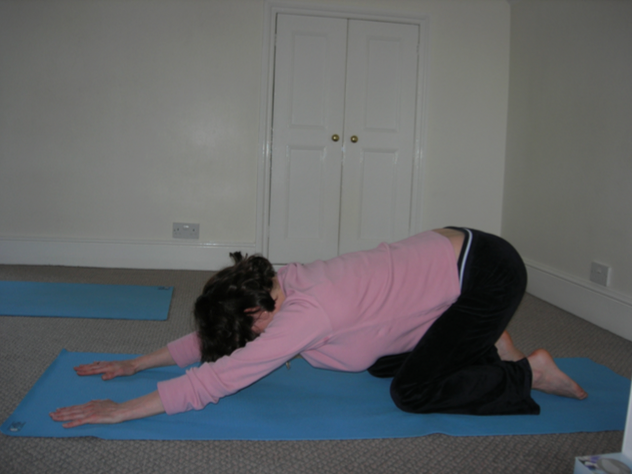
Child's Pose Balasana/Pranatasana As you exhale, allow the active weight of the pelvis to lengthen the spine through from the shoulders, the upper back, the waist - to the tailbone Be comfortable with the sacred space within yourself

Child’s Pose Balasana/Pranatasana
As you exhale, allow the active weight of the pelvis to lengthen the spine through from the shoulders, the upper back, the waist – to the tailbone
Be comfortable with the sacred space within yourself

Judy Cameron January 2013